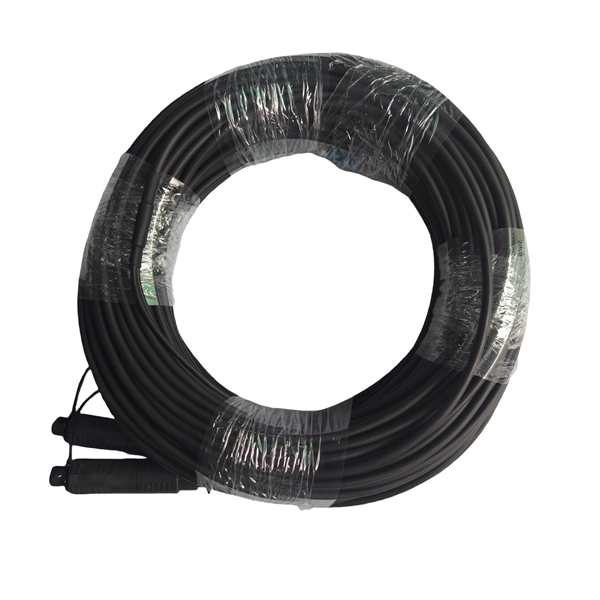
A Raman Fiber Amplifier (ROA) is an optical amplifier that uses stimulated Raman scattering in the transmission fiber to amplify signals, offering distributed gain, low noise, and broadband operation.Operating Principle
Raman fiber amplifiers work based on stimulated Raman scattering (SRS), where a high-power pump laser transfers energy to a lower-frequency signal propagating in the fiber . The pump and signal can propagate co-directionally or counter-directionally, and the signal wavelength is typically a few tens of nanometers longer than the pump. The energy transfer occurs along the transmission fiber itself, making the amplification distributed rather than localized, which improves the optical signal-to-noise ratio (OSNR) and reduces nonlinear effects compared to lumped amplifiers like EDFAs .
Advantages
- Broadband Amplification: By using multiple pump wavelengths, ROAs can amplify a wide range of signal wavelengths, supporting ultra-broadband and DWDM systems .
- Low Noise Figure: Distributed amplification reduces noise accumulation, enhancing OSNR and enabling longer transmission spans without regeneration .
- Reduced Nonlinear Effects: Lower average signal power in the fiber minimizes four-wave mixing and other nonlinear impairments .
- Flexibility in Deployment: ROAs can be used in challenging environments like submarine cables or remote terrestrial links where installing repeaters is difficult .
Performance Comparison with EDFA
Studies show that ROAs can outperform EDFAs in certain scenarios, particularly in maintaining bit error rate (BER) and Q-factor across a range of input powers in CWDM and DWDM systems . ROAs provide higher received power and better system performance over long distances, while EDFAs are centralized and may require more repeaters for ultra-long-haul links. Hybrid systems combining ROA and EDFA can further optimize noise performance and extend transmission distance .
Limitations
- Lower Gain per Stage: Typical Raman fiber amplifiers provide gains below 15 dB, requiring higher pump power or multiple stages for long-haul applications .
- Pump Power Requirements: High pump power (on the order of 1 W) is needed, which may raise laser safety concerns .
Applications
ROAs are widely used in long-haul terrestrial and submarine optical networks, ultra-long-haul DWDM systems, and scenarios requiring broadband, low-noise amplification without frequent regeneration . They are particularly valuable in extending the reach of existing fiber infrastructure while supporting high-capacity data transmission. In summary, Raman Fiber Amplifiers provide distributed, low-noise, and broadband optical amplification, making them a key technology for modern high-capacity optical communication systems, often complementing or outperforming traditional EDFAs in long-haul and high-bandwidth applications .